






Personnel de l'université
Daniel MAUVOISIN
Contact details
- Phone
- 0228080010 (n° interne : 320010)
- Daniel.Mauvoisin@univ-nantes.fr
- Personal Website
- https://orcid.org/0000-0003-0571-0741
Research topics
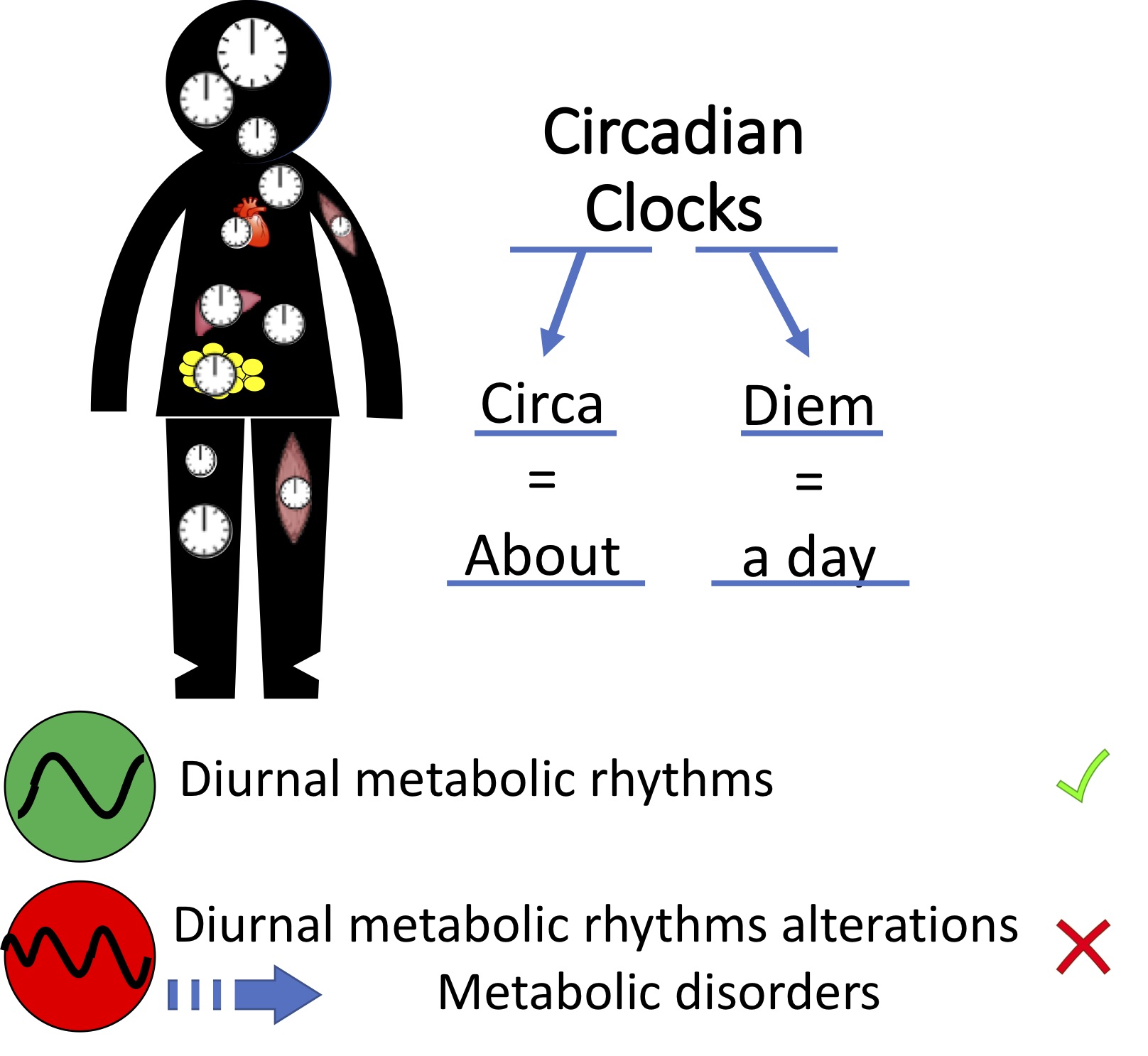
Modern lifestyles have led to a surge in chronic non-communicable diseases, and exposure to circadian disruptors, such as irregular sleep patterns and altered dietary habits, constitute risk factors for overweight, obesity, and metabolic complications.
The circadian clock is a hierarchical regulatory network that plays a central role in metabolic regulation. Its dysfunction is associated with a broad range of pathologies, including obesity and type 2 diabetes. This endogenous molecular oscillator regulates circadian (~24-hour) metabolism through multiple regulatory layers, ranging from transcriptional control to post-translational modifications. At the cellular level, the circadian clock also governs the dynamics of subcellular structures, including mitochondria, which serve as central hubs of metabolic rhythmicity, thereby safeguarding metabolic homeostasis. Consequently, the repertoire of circadian clock outputs is remarkably broad and includes hormones, nutrients, redox sensors, and metabolites. These metabolic outputs can, in turn, regulate the circadian clock and diurnal metabolism by acting as input signals (zeitgebers). Feeding rhythms represent one of the most potent zeitgebers, and feeding-associated cues can also entrain peripheral circadian clocks.
One of the major challenges in the field of circadian metabolism is to identify the molecular mechanisms through which feeding schedules influence circadian metabolism. A key outstanding question is whether overnutrition, a well-established circadian disruptor, promotes metabolic disease by perturbing the rhythmicity of metabolism-related post-translational modifications and/or by disrupting mitochondrial metabolic rhythms.
- Le Questel E., Besnard C., Atger F., Foucher Y., Tollec A., Pakulska V., Rodrigues Oliveira A., Clotteau C., Gourdel M., Nemazanyy I., Croyal M., Coute Y., Jacobi D., Cariou B., Mauvoisin D. # Diurnal regulation of Acyl-CoA synthetase 3 (ACSF3) governs rhythmic mitochondrial lysine-malonylation and daily hepatic metabolism. Cell Reports. 45, 117774 (2026). doi.org/10.1016/j.celrep.2026.117774
https://u-news.univ-nantes.fr/le-rythme-alimentaire-coordonne-le-metabolisme-hepatique
- Atger F., Durand D., Croyal M., Chavanne A., Le Questel E., Foucher Y., Besnard C., Nemazany I., Le Lay S., Prieur X., Pecqueur C., Mauvoisin D.#, Jacobi D.# Chronopharmacological targeting of mitochondrial dihydroorotate dehydrogenase prevents diet-induced obesity in male mice. 2026. BioRxiv. doi: doi.org/10.64898/2026.04.18.719366
- Weger M., D. Mauvoisin, D. Hoyle, J. Wang, E. Martin, J. Rae, C. Ferguson, G. Klinke, M. Cielesh, K. L. Macauslane, M. Larance, M. Quadroni, I. Templeman, J.P. Walhin, L.G. Karagounis, J. Betts, J. D. Johnston, F. Durussel, D. Firsov, S. Fournier, O. Müller, B.L. Schulz, R. G. Parton, B. D. Weger and F. Gachon. Feeding-regulated glycogen metabolism drives rhythmic liver protein secretion. Nat Metab. 2026 Feb 5. doi: 10.1038/s42255-026-01453-8.
- Mauvoisin, D., Gachon, F. Proteomics in Circadian Biology. J. Mol Biol. Volume 432, Issue 12, 29 May 2020, Pages 3565-3577. doi.org/10.1016/j.jmb.2019.12.004
- Mauvoisin, D., Circadian rhythms and proteomics: It's all about post-translational modifications! Wiley Interdiscip Rev Syst Biol Med. 2019 Apr 29:e1450. doi: 10.1002/wsbm.1450.