




Virgil Viasnoff, Aix Marseille University
-
On 08 January 2027Amphi DEfalse false
-
11h30
Biofunctionalized 3D scafolds to guide the development et spatial organisation of Cardiac and liver organoids from hIPSCs
Biofunctionalized 3D scafolds to guide the development et spatial organisation of Cardiac and liver organoids from hIPSCs
Virgile Viasnoff, PhD
DR, Directeur adjoint FranceBioimaging
IBDM – UMR 7288
Biography
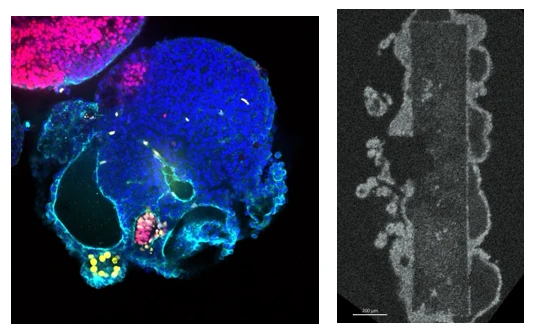
Virgile Viasnoff is a directeur de recherche at CNRS (Marseille) in biophysics. His team works on understanding the role of the microenvironment on cell-cell interactions. They developed new tools to control and characterize the development of lumens in liver at the single cell level (bile canaliculi) and at the multi cellular level (bile duct). They recently developed an approach to create artificial organizing centers to control the differentiation of stem cells in 3D. They look at the role of development of local microniches in the structuration of cardiac and liver organoids.
Abstract
In this presentation, we will explore the role of spatially distributed growth factors in directing stem cell differentiation and tissue organization. I will introduce an experimental strategy that employs 3D colloidal scaffolds biofunctionalized with growth factors and embedded within spheroids of human stem cells. These scaffolds act as artificial organizing centers, guiding the spatial architecture of cardiac and liver organoids. I will demonstrate how the localization of these artificial centers influences the intrinsic secretion and deposition of tissue-specific extracellular matrix, which in turn directs cell differentiation and morphogenesis through the self-organized formation of local microniches. I will present results showing how this approach enables the in vitro recapitulation of periportal area development in the human liver and promotes the guided elongation of millimeter-scale bile ducts. Finally, I will discuss the potential of these colloidal scaffolds to support the assembly and spatial integration of multi-organ assembloids.