





Mathematical modelling of cardiac arrhythmias
Investigator : Rupamanjari Majumder
Postdoc: Navneet Roshan
Support staff : Elouan Voisin
I combine state-of-the-art numerical, theoretical and experimental techniques, and in particular computational cardiac optogenetics, to answer interdisciplinary questions about the mechanisms underlying the occurrence, progression and control of lethal cardiac arrhythmias. My particular expertise is in the development of experimental data-driven, predictive, multi-scale, multi-component mathematical models used to study complex cardiac arrhythmias, such as fibrillation and tachycardia, in various pathologies. Using interdisciplinary methods, I explore new ways to control arrhythmic electrical patterns in excitable cardiac tissue. These studies form the basis for the development of new therapeutics.
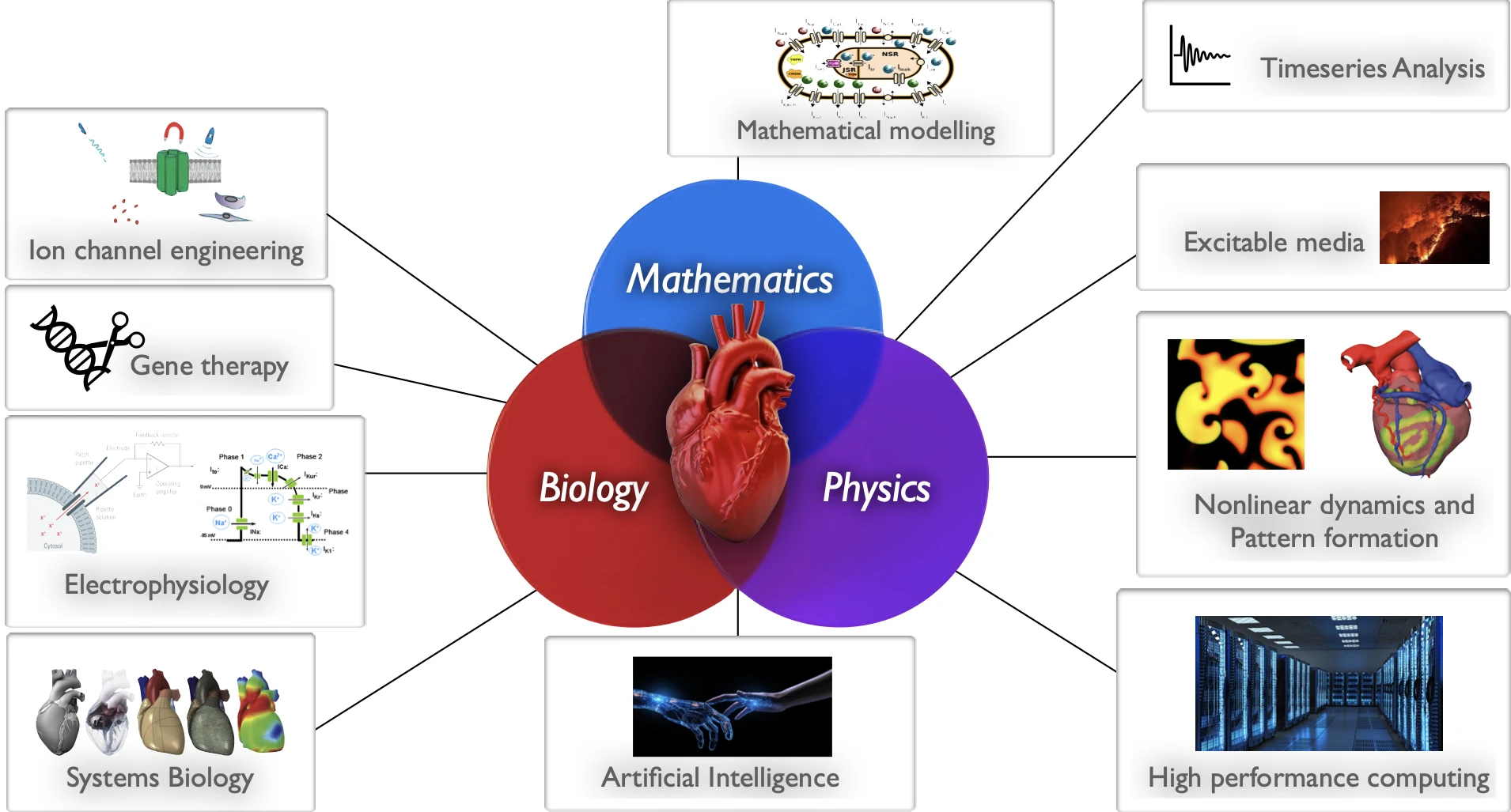
Cardiac arrhythmias play an important role in causing sudden cardiac death, which is responsible for 15-20% of annual morbidity worldwide. Unfortunately, the state of the art in the treatment of these arrhythmias remains suboptimal. The development of new and effective therapies is severely hampered by the lack of a comprehensive understanding of the disease, which stems from its complex and multi-faceted nature, involving genetic abnormalities, anomalies in function, expression and/or subcellular distribution of ion channels, atypical calcium handling, altered ion trafficking and the occurrence of structural heterogeneities such as fibrosis, adipose infiltrates etc. These factors, independently or in groups, manifest at the organ level as dynamically evolving, irregular electrical activity. Thus, precise identification of the exact mechanisms underlying an arrhythmia can become extremely difficult.
My work takes a bottom-up approach to cardiac arhythmia research. At the subcellular level, I develop fingerprints for customised ion channels. Together, these ion channels form the cell model that I design based on experimentally obtained electrophysiological data.
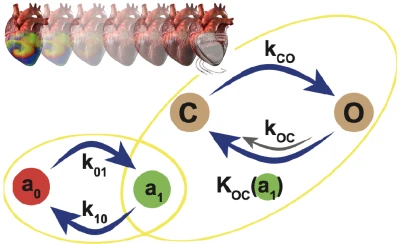
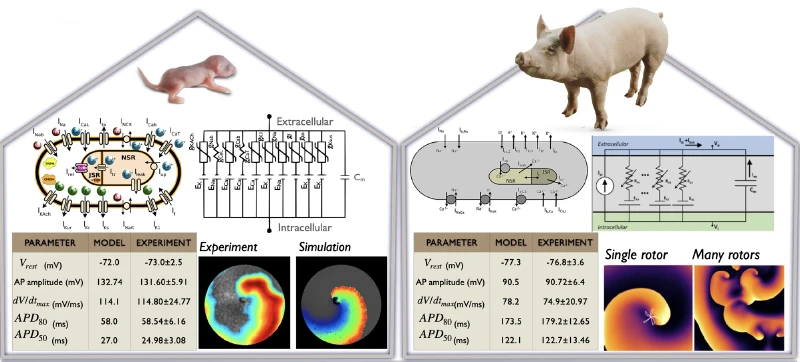
(Left) Ion channel designing (Example shown, is the BioICD: Majumder et al. eLife 2020). (Right) Mathematical models of neonatal rat (Majumder et al. PLoS Comp Biol, 2016) and adult pig (Peris et al. Front Physiol, 2022) atrial cardiomyocytes.
Once the cell model is developed, I extend it to higher dimensions to simulate the spatiotemporal dynamics of electrical waves in cardiac tissue. In particular, my work focuses on (i) the emergence of spiral waves (onset of arrhythmias), (ii) their interaction with inhomogeneities (arrhythmias in the presence of scar tissue), (iii) transitions between different spiral wave states (arrhythmias changing morphology), (iv) the occurrence of electrical turbulence (onset of fibrillation), and (v) low-energy methods to control these waves in different disease substrates (cardiac defibrillation). To understand mechanisms underlying lethal cardiac arrhythmias in monolayers, I use cardiac optogenetics, which is a cutting-edge technique that endows ordinary, photoinsensitive cardiac cells with photosensitivity towards light of specific wavelengths. I use this technique to understand, manipulate and control the complex dynamics of spiral waves (arrhythmias).
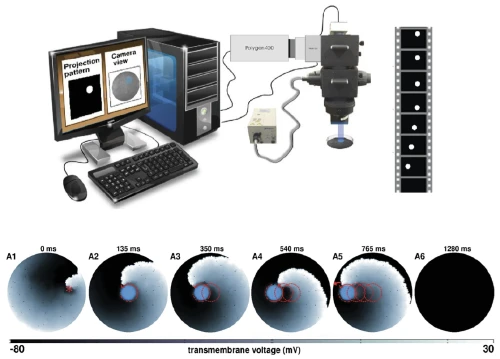
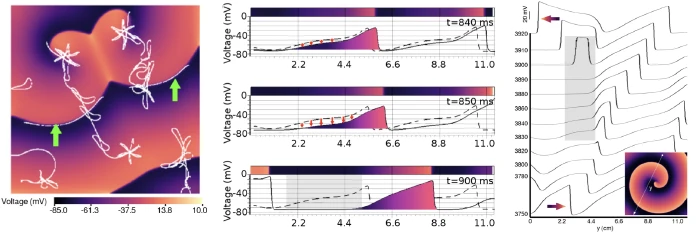
(Left) Manipulation of spiral waves in in silico cardiac cell culture using optogenetics (Majumder et al. eLife, 2018) (Right) Unravelling the mechanisms of wave break initiation (initiation of complex arrhythmias) in an in silico model of human atrial tissue (Majumder et al. PLoS Comp Biol, 2021)
Finally, I study the manifestation of a diseased condition at the organ level. I am currently working on developing a multiscale, integrated digital platform - the Heart-by-Numbers - for the human heart that can be used by clinicians to predict the trajectory of an arrhythmia from its onset to progression, based on ECG recordings. The platform is also intended for use in testing novel therapeutic approaches, such as photo-pharmacology.
Photon-scanning approach to control spiral wave dynamics in the heart. L Diaz-Maue, VS Zykov, R Majumder. Physical Review Letters, 2024 Nov
A mathematical model for electrical activity in pig atrial tissue V Peris-Yagüe, T Rubio, FE Fakuade, N Voigt, S Luther, R Majumder. Frontiers in Physiology, 2022 Mar
Self-restoration of cardiac excitation rhythm by anti-arrhythmic ion channel gating. R Majumder, T De Coster, N Kudryashova, AO Verkerk, IV Kazbanov, Balázs Ördög, Niels Harlaar, Ronald Wilders, Antoine AF de Vries, Dirk L Ypey, Alexander V Panfilov, Daniel A Pijnappels. Elife, 2020 Jun
Optogenetics enables real-time spatiotemporal control over spiral wave dynamics in an excitable cardiac system. R Majumder, I Feola, AS Teplenin, AAF de Vries, AV Panfilov, Daniel A Pijnappels. Elife 2018 Sep
Optogenetic manipulation of anatomical re-entry by light-guided generation of a reversible local conduction block. M Watanabe, I Feola, R Majumder, W Jangsangthong, AS Teplenin, Dirk L Ypey, Martin J Schalij, Katja Zeppenfeld, Antoine AF de Vries, Daniël A Pijnappels. Cardiovascular research, 2017 Mar
Funding
- Agence Nationale de la Recherche
- INSERM